Showing posts with label "Reading for Life". Show all posts

Monday, June 6, 2011

School of Business dean finalists to visit campus

From the office of University Communications:

The three finalists for the position of Albert O. Nicholas Dean of the Wisconsin School of Business at the University of Wisconsin-Madison will be on campus in coming days.

Each finalist will spend two days on campus visiting and meeting with people at UW-Madison as the final part of the search-and-screen process.

During their visits, the three finalists will have contact with the broader campus community, from meetings with Chancellor Biddy Martin and Provost Paul DeLuca to gatherings with academic deans, shared governance groups, and students, faculty, staff, alumni and other members of the Wisconsin School of Business community.

The candidates will also hold open sessions in Grainger Hall, 975 University Ave., to answer questions from those interested in the future of the Wisconsin School of Business.
  • Monday, June 6: Michael Trick, professor of operations research and associate dean for research in the Tepper School of Business at Carnegie Mellon University, 10:30 a.m.
  • Wednesday, June 8: Anil K. Makhija, Dean's Distinguished Professor of Finance in the Fisher College of Business at The Ohio State University, 2:30 p.m.
  • Wednesday, June 15: François Ortalo-Magné, Robert E. Wangard Professor of Real Estate at the Wisconsin School of Business, 10:30 a.m.
Live webcasts of the candidate presentations will be available at http://www.bus.wisc.edu.

This morning was the first of the presentations, with Michael Trick. As part of his presentation, he mentioned two books on the future of graduate level business education. I thought this was a good fit for our Reading for Life series (originated by Prof. Stephen Malpezzi, see previous entries in the series here).

The first is Rethinking the MBA by three Harvard researchers Srikant Datar, David A. Garvin, and Patrick G. Cullen; and the other is From Higher Aims to Hired Hands by Harvard professor Rakesh Khurana.

There certainly is no shortage of books on the subject of higher education. Have you read either of these books? What do you think of them? Please share your thoughts in the comments.

Wednesday, January 26, 2011

WBA 2011 Economic Forecast: Business Fundamentals

Recently the Wisconsin Bankers Association organized its 2011 Economic Forecast Luncheon (listen to audio), held at Madison’s Monona Terrace. Graaskamp Center Academic Director Stephen Malpezzi attended as the guest of our friend Kurt Bauer, WBA president and CEO. (Kurt and his colleagues are also sponsors of our annual Wisconsin Real Estate and Economic Outlook conference, along with the Wisconsin REALTORS Association, WHEDA, and the Wisconsin Department of Commerce; mark your calendars now for June 9, 2011.)

The conference was opened with brief remarks by Jeff Mayers, WisPolitics.com and WisBusiness.com. The main program comprised a speech by Wisconsin’s new governor Scott Walker, and a keynote address by the president of the Federal Reserve Board of Minneapolis Narayana Kocherlakota.

The theme of Governor Walker’s remarks was “Wisconsin is open for business.” He outlined a series of planned initiatives in taxation, incentives, and regulatory relief, as well as a reorganization of the Wisconsin Department of Commerce. The governor’s call for subjecting regulations to a cost-benefit analysis is consistent with a long strand of research at the University of Wisconsin, from James Graaskamp’s analysis of the proper role of the “infrastructure producer’s group” (aka “government”) in his classic ULI monograph “Fundamentals of Real Estate Development” to Malpezzi's research on land use and development regulations ["House Prices, Externalities and Regulation in U.S. Metropolitan Areas." Journal of Housing Research. 1996], rent controls, and their public interventions. A Wisconsin economics PhD, Timothy Bartik, has written one of the deepest and richest analyses of these interventions “Who Benefits from State and Local Development Policies?” (a Reading for Life “Top Twelve”!).

Dr. Kocherlakota’s talk was framed by one of our favorite real estate movies: It’s a Wonderful Life. But instead of asking how Bedford Falls would have fared without George Bailey and his eponymous Building & Loan, Kocherlakota asked how the economy would have fared over the past three years without the extraordinary actions taken by the Federal Reserve, and are continuing in “QE2” (Quantitative Easing II).

Kocherlakota pointed to the key role played by volatility in land and real estate markets in the economic events of the past decade. He didn’t provide references in his talk but, in his academic papers on the subject (and in post-speech conversations), he cites our own Morris Davis as his source on land price data and analysis.

We have a lot of evidence—back through the 80s—that volatility in housing/land prices is driven in part (but in important ways) by the things that affect the supply of real estate product—regulatory constraint and natural geography. See Malpezzi's paper with Susan Wachter, The Role of Speculation in Real Estate Cycles, for example.

The role asset prices, especially housing, play in the recent economic and financial crisis has reopened the question of whether central banks should continue to make policy based primarily on prices as measured by the Consumer Price Index and similar price measures; or whether they should also consider the prices of assets, like housing and stocks. In response to a question from Malpezzi during Q&A, Kocherlakota said that the Fed should not use asset prices to fix monetary policy. Instead asset prices should be an element in designing regulatory oversight of financial institutions.

Monday, December 20, 2010

Observations on Essays, Blogging, and Reading for Life

by Stephen Malpezzi, Professor and Lorin and Marjorie Tiefenthaler Distinguished Chair in Real Estate

Regular readers of Wisconsin Real Estate Viewpoint have read some of my missives about “Reading for Life.” Some of you may have even downloaded the very long list (pdf) I’ve posted at my web page on selected teaching materials.

Given my research and teaching interests, it’s no surprise that most of the readings I’ve pointed to relate to real estate, economics, cities, globalization, etc. Today let me step out of my usual zone.

This morning reading The New York Times (paper version! I’m old school) I ran across a short article playing off Sarah Bakewell’s new book, How To Live: Or A Life of Montaigne in One Question and Twenty Attempts at an Answer.

The article, “Conversation Across Centuries With the Father of All Bloggers” (Patricia Cohen, published December 17, 2010) caught my eye because I remember reading some 16th century Montaigne essays many, many years ago. Certainly there were short-form writers before Montaigne – many classical authors from Greek and Roman days, Pauline Epistles and Montaigne’s near-contemporary Francis Bacon come to mind. Nevertheless, Montaigne is considered by some as the father of the essay as we know it today.

Although I’m not sure there is a water-tight definition of the essay. Subjects are all over the map; it’s usually (not always!) a shorter piece; and an essayist often puts forward a personal point of view. Why, it seems I am writing a short essay now! You’re an essayist too – if you’re a current or past student at Wisconsin Real Estate, you surely wrote a number of personal essays explaining why you’d make a great addition to the Badger student body, the Wisconsin School of Business, and perhaps the Graaskamp Center.

As the title of Cohen’s article suggests, one of the points that Bakewell makes in her book is that the essay is the precursor of the blog. Short, personal, and written on a variety of topics. Sounds like the Wisconsin Real Estate Viewpoint to me!

So it’s time to add some of my favorite essayists to Reading for Life.

One of the great things about the internet is that many of the great essayists of the past is that their work is now in the public domain and available for free. I like aphorisms, so I spent a little time browsing George Bernard Shaw’s essay Maxims for Revolutionists. What I like about Shaw’s aphorisms is how he turns the way I usually think upside down. For example, in the Tradition and Innovation paper I briefly discuss the “golden rule” approach to some ethical questions; but Shaw the economist reminds me that there are exceptions: “Do not do unto others as you would that they should do unto you. Their tastes may not be the same.” Consumer sovereignty!

We just had a very successful Graaskamp on the Road in New York, which brings to mind another favorite, E.B. White’s 1949 essay, This is New York. Part paean, but also very clear-headed and realistic.

White, like many other top essayists, often wrote for The New Yorker. One could spend weeks reading great essays from this single source – James Thurber, Joyce Carol Oates, Calvin Trillin and John McPhee come to mind.

James Graaskamp himself was no mean essayist – Principles of Real Estate Development and A Rational Approach to Feasibility Analysis are among his works that fit the form.

Perhaps thinking about the great essayists will help me be a better blogger. The next time I make it over to the reference section of Memorial Library I’ll have a look at Tracy Chevalier’s 1997 Encyclopedia of the Essay.

But in the meantime I downloaded a free version of Montaigne’s collected essays, to browse through when I need a break from grading. Leave a comment with your favorite essayist!

Photo by Djof via Flickr

Monday, November 1, 2010

Economics and elections

by Stephen Malpezzi, Professor and Lorin and Marjorie Tiefenthaler Distinguished Chair in Real Estate

One of the goals of my urban economics classes is to demonstrate how we can use economics, and data analysis, to understand a range of events in real estate markets, in cities, and in our society more broadly.

Tomorrow's midterm election provides us with a great set of teachable moments. I'm using the effect the economy can have on the election to illustrate some basic techniques of data analysis, critical thinking, and "storytelling;" and, as always, how "Reading for Life" can help us make sense of the world.

Today, I'd like to share just a few of these points, focusing less on the data analysis techniques and more on some interesting stylized facts and research results (mainly results from other people's research).

While much debate surrounds causes, timing, and attribution, the objective fact is that, by some measures, the economy is in the worst shape since the Depression. The next two figures show how two indicators, growth in GDP per capita and inflation, fared during the terms of the postwar presidents since Truman. (The data go back to 1947 and so the early part of Truman's term is omitted. The data run through Q2 of 2010, so the last few months of the Obama administration are also omitted). Let me start with two indicators that previous research has tied to electoral performance.FIGURE 1. President Obama, so far, has faced a lower growth rate of GDP per capita than any other postwar president. Of course, it's early days, and whatever our partisan leanings, we all hope for better performance in the next two years. Nevertheless, the anemic performance of GDP growth is a challenge for Democrats (who, of course, also control the House and the Senate, at least by the simple definitions of "control.")
FIGURE 2. On the other hand, Obama has held office during a period that's exhibited lower average inflation than we've seen during any other postwar President's term.

Are Presidents responsible for “their” economic averages?
A huge body of research argues the effects of economic policies (taxes, subsidies, deficits, regulations…) and Presidents (and other politicians) do affect these policies. However, the economy has a lot of inertia (lags) built in, and there is a lot of luck involved. (Luck, of course, can be good or bad.) Policies have their lags, too. The economy can react to the perception of future policies and uncertainty in the same. But fair, or not, there is a lot of evidence that election outcomes are affected by the performance of the economy, even over short periods.

Economist Ray Fair (Yale) has published several papers and a book about how to forecast U.S. elections according to the state of the economy. Recently he extended his work from Presidential elections (as in his book) to House elections, in “Presidential and Congressional Vote-Share Equations,” American Journal of Political Science, 53(1), January 2009, pp. 55-72

Ray Fair’s prediction of this week’s Congressional election
Fair’s model has three equations: for the Presidential vote, the “on-term” House vote, and the midterm House vote. The economic variables are derived mainly from growth in GDP per capita and inflation. Other variables include whether there is a Presidential election, and if there’s a war on. Fair’s latest forecast (10/29/10) is that the Democratic share of the House vote will be 49.2%, i.e. a razor-thin Republican majority. He doesn’t forecast Senate results.

What about unemployment?
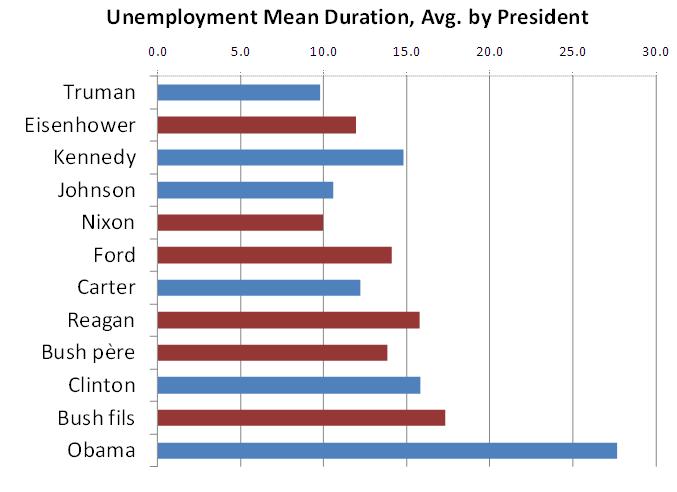
Fair’s model shows the House vote as closer than most political pundits. The two main economic drivers in his model are GDP per capita growth and inflation. Current low inflation numbers are helping to keep it close. I think the other thing this model misses is our high unemployment and its extraordinary average duration. See the next two figures:


These are even worse than might be expected from our recent growth in GDP; see for example the analysis by the Federal Reserve Bank of San Francisco. High unemployment, and high duration, and how they are now driving foreclosures, are subjects my colleagues and I have discussed elsewhere.

Debate will continue on the efficacy of the policies of the Administration and Congress; between Republicans and Democrats; and the debate that’s always on within the parties.

Despite my PhD in economics, I’d never argue that elections are only about my favorite subject.

But objective data, and past research on elections, show that the state of the economy has an important effect on the electoral fortunes of the party in power. Fairly or not, economic conditions favor the Republicans this time around.


More "Reading for Life"

Tuesday, September 7, 2010

Ben Bernanke's "Reading for Life"?

The New York Times' Economix blog last week highlighted some readings on the financial crisis recommended by Fed Chairman Ben Bernanke. One recommendation in particular, Liaquat Ahamed’s “Lords of Finance: The Bankers Who Broke the World,” seemed familiar.

Our own Stephen Malpezzi, professor and academic director of the Graaskamp Center, included Ahamed's book on his Dynamic Dozen list of top books in his 2010 Reading for Life list.
Dr. Ahamed is a polymath who used to work at the World Bank; we overlapped there though our paths did not really cross. Anyone who has read World Bank reports will be stunned to find out that he writes beautifully.
We've highlighted some entries from his list in previous posts, and I highly recommend checking out the list in its entirety for a wide range of worthwhile reads.

Friday, July 23, 2010

Bobos in Paradise

By Stephen Malpezzi, Professor and Lorin & Marjorie Tiefenthaler Distinguished Chair of Real Estate

Whatever your politics, discerning readers of the op-ed columns recognize center-right columnist David Brooks as one of the very best at his craft. Trained as a journalist but knowledgeable about a range of social sciences, his book Bobos in Paradise gave a popular introduction to “bourgeois bohemians,” a word Brooks coined to describe the nineties version of earlier “yuppies:” upper-class, educated, and ready to spend, but on goods (argues Brooks) like granite countertops or high-end electronics that are positioned as functional, rather than something expensive but frivolous from the Neiman-Marcus Christmas catalog. (Colleague David Shulman recommended the book to me, and it makes my Reading for Life list.)

Brooks has written two recent columns that speak to me as we prepare for the year’s classes and an influx of students. The first column appeared in The New York Times on July 9th (“The Medium Is the Medium”). In it, Brooks nods to the many benefits of the Internet, email and the rise of social media, but he also makes a pitch for the importance of old-fashioned books. Readers of my introduction to Reading for Life will know this is a position I’ve staked out as well. Research by Jacob Vigdor and Helen Ladd, cited by Brooks, is the most comprehensive study I’ve ever seen on the impact of personal computers on student achievement. This study, “Scaling the Digital Divide: Home Computer Technology and Student Achievement,” is still in working paper form but is destined to become a classic (I’ll address it more fully in a future entry). The take-away for the moment is this: simply providing your child a PC and an Internet connection is no guarantee that they’ll excel in school; in fact it may bring their performance down. Books, on the other hand, rule.

The other recent Brooks column that speaks to our educational mission is the July 13th “An Economy of Grinds.” Brooks describes “princes” as business people, often those at the top, who have great social skills, including an ability to integrate and “tell a story” about a situation. “Grinds,” on the other hand, are driven loners, often almost anti-social, ready to take a contrarian view. Both can be arrogant, but the grinds, while not always obvious about it, are often really arrogant. Citigroup’s Charles Prince (he’s even got the name!), “as long as the music’s playing, you’ve got to get up and dance,” versus Michael Barry, one of the first to get the MBS market right, rarely left his office and took poor investor relations to a new level.

But really, Brooks is not completely fair to either grinds or princes. The best business leaders combine both. Think Jack Welch, not Alec Baldwin’s Jack Donaghy on 30 Rock. Or think of our own James Graaskamp’s oft-quoted statement that a UW grad should be a combination of da Vinci, Muir and Rouse.

At Wisconsin, our goal should be to turn out grinds who can tell a story, princes who aren’t in thrall to the latest investment fad. Our students and alums need to think independently but be able to communicate—both up and down the food chain!—inspire and persuade. In future posts, we’ll talk about some of the hard and soft skills we all need to master throughout a lifetime of learning.


“The result [of an academic program] should be a real estate entrepreneur with the creativity of Leonardo da Vinci, the sensitivity for the natural world of John Muir and the political humanity with cash management for profit of James Rouse.”
James A. Graaskamp (1933-1988), professor and chair of the UW-Madison Department of Real Estate and Urban Land Economics

Tuesday, June 22, 2010

Reading for Life: Nature's Metropolis

Book recommendation from Professor Stephen Malpezzi's Reading for Life list:

Cronon, William. Nature's Metropolis: Chicago and the Great West. W.W. Norton, 1991.

Bill Cronon is the Frederick Jackson Turner and Vilas Research Professor of History, Geography, and Environmental Studies at UW–Madison. He is a leading historian on environmental issues as well as the development of Chicago.

In his book, he explains how Chicago rose from a small Midwestern town of just a few thousand people to one of the big U.S. cities in only a few decades. The city's position as a focal point for the meatpacking and farming industries blossomed as a result of the railway connecting it with the East Coast and the invention of the refrigerated rail car.

Even though the book is principally about Chicago, much is written about the surrounding area of Illinois and southern Wisconsin. Madison's particular contribution was ice. Lakes Mendota and Monona supplied ice that cooled those refrigerated boxcars.

Just the thing on a hot summer day! Read more about Professor Malpezzi's Reading for Life list here and catch up on previous posts in the series here.

Monday, May 24, 2010

Summer reading

Reading for Life by Stephen Malpezzi, Professor and Lorin and Marjorie Tiefenthaler Distinguished Chair in Real Estate


Want to take a little time out from tweeting, unplug your iPod, close up Facebook, shut down your blog, and … read a book?

I recently updated my Urban Economics course Reading for Life list (undergrad, Real Estate 420; master's level, Real Estate 720). These are mostly books, but I will recommend a few periodicals, journal articles, and even blogs.

Over the course of the summer, we'll pass along some recommendations from the list. Of course, just because a book is listed here, even if it's one of my special favorites, doesn't imply I agree with the author. Whether you, or I, agree with an author or not, always read with our class motto in mind--Don't be a sap. And stay tuned for future posts where we'll share more book picks and possibly our Class Slogan and Class Mantra.

Let's start with a couple of books that were mentioned during the recent spring meeting of our Board of Advisors:


Thaler, Richard H. The Winner's Curse: Paradoxes and Anomalies of Economic Life. Princeton University Press, 1992.

This book shows how recent theoretical advances in game theory help us understand real world issues in bidding, etc. If you think you'll be buying or selling real estate – or anything else – in your future career, read it.


Reinhardt, Carmen M. and Kenneth S. Rogoff. This Time Is Different: A Panoramic View of Eight Centuries of Financial Crises. Princeton University Press, 2009.

Note the IRONY in the title. This is a masterful work of scholarship.


I update this several times a year. I’m always interested in what students and alums are reading along these lines as well. Please share your feedback in the comments below.

Previous Reading for Life highlights include In Fed We Trust.

Tuesday, January 19, 2010

2010 Wisconsin Economic Outlook

In the cover story for this month's Wisconsin Real Estate Magazine, Stephen Malpezzi shares his outlook on the economy in Wisconsin and beyond. In his article, he mixes the good news with the not-so-good:
"(A) number of observers, not least Federal Reserve Chairman Ben Bernanke and White House advisor Larry Summers, believe the recession is over. But the consensus view at the Graaskamp Center for Real Estate is that it’s too soon to be confident we’re in recovery."

"House prices are now roughly in line with fundamentals like incomes, interest rates, and rents...But we are concerned that just as house prices overshot going up, they could overshoot going down."
Visit the WRA for the full text of his outlook from the January issue.

Malpezzi also has an addition to his recommended reading list, "Carmen Reinhart and Ken Rogoff’s masterful This Time is Different: Eight Centuries of Financial Folly."

Share your thoughts on the book and the article in the comments.

Tuesday, January 5, 2010

Reading for life

Stephen Malpezzi shares one of the titles on his "Reading for Life" book list.

At Wisconsin, we’re big on the idea of “lifetime learning.” The few years you spend in Madison in Bucky’s warm embrace are only the beginning of your real estate education. We want to partner with your education over the following 50 years, too. And, consistent with the Wisconsin Idea that the university has no boundaries, we want to be a part of your education even if you’ve never been lucky enough to set foot in Mad City.

In my urban economics courses, I try to find time to point out books and articles outside that course’s curriculum that fit that lifetime learning model. In that spirit, from time to time I’ll use this blog for short book reviews.

Let’s start with one of my recent favorites, In Fed We Trust: Ben Bernanke’s War on the Great Panic; How the Federal Reserve became the Fourth Branch of Government. If the full title is a little long, the double subtitles do give a fair view of the contents. The book was written by David Wessel, the Wall Street Journal's economics editor, and frequent contributor to National Public Radio. He is a very interesting and generally reliable voice on economic matters.

In Fed We Trust tells the story of the fall 2008 economic crisis, through the perspective of the actions of Fed Chairman Bernanke and a small group of policymakers, including Henry Paulson at Treasury, Timothy Geithner (then at the New York Fed), Kevin Warsh at the Fed, and others like FDIC’s Sheila Bair and the SEC’s Christopher Cox.

We're still in the middle of the economic crisis, and academics will argue over the causes and the policy responses for decades. Nevertheless, this book is a terrific first look. It's a clear and readable narrative focusing on a particularly critical time. Other books and articles dig deeper into the root causes, and present more data and analytics – see, for example, Restoring Financial Stability: How to Repair a Failed System, edited by Viral Acharya and Matthew Richardson; or Jim Barth’s Rise and Fall of the U.S. Mortgage and Credit Markets.

The broad outlines of the crisis are familiar. Over the long run, house prices in the U.S. rise slightly more than inflation, on average (see: Malpezzi and Maclennan, The Price Elasticity of Supply of New Housing in the U.S. and the United Kingdom, Journal of Housing Economics, 2001). But as my colleague Morris Davis and I show in this chart, starting around 1996, U.S. house prices began a decade-long run-up, increasing an inflation-adjusted average of 7 percent per year, clearly an unsustainable situation. Nevertheless, many borrowers, lenders, investors, and some analysts and policymakers appeared to believe large real house prices could be sustained indefinitely, in defiance of history and logic. After the 2007 turn in housing markets, and the subsequent collapse of mortgage backed security and other markets, by September 2008, U.S. financial markets and indeed the entire economy stared into an abyss. This book is the story of the small group of key officials whose responses to that crisis plausibly they kept us from falling into the abyss.

We all know that will never know the true counterfactual – exactly what would've happened to the economy really if the actions described in this book had not been undertaken. Based on the available data and reportage, my personal view is that it would have been extremely dire indeed. A complete freeze up of the global financial system could have led to a much larger contraction in real economic activity and does walk taken us down a path of deflation and extreme unemployment from which recovery would take years – see Japan’s experience. During this period Bernanke et al. dealt with massive failures at Bear Stearns, Lehman Brothers, AIG, IndyMac, Fannie and Freddie, and others.

It's interesting to contrast Bernanke with his predecessor Alan Greenspan. As an economist, by all accounts Greenspan is an excellent clarinet player. As a fellow data freak, I have to admit to a certain admiration for Greenspan's eclectic data-diving. But even data freaks need a good conceptual framework, and an ability to do serious empirics that make sense of the data; or at least we have to understand the frameworks and empirics of others. A good economist also needs to know when to step back and give up on a particular view. Keynes’ famous statement, “When I find I’m mistaken, I change my mind. What do you do?" comes to mind. Bernanke went into the crisis with many of the same prior beliefs as Greenspan, more or less. But it’s impossible to overestimate the importance of this difference between the two men: when events showed their prior beliefs about the economy’s workings, and the Fed’s appropriate policies, were mistaken, Greenspan was left only with an ideology, and his deep yet by then irrelevant knowledge of the more obscure economic statistics. Bernanke had the flexibility to adjust his conceptual framework, and move into a mode that was demanded by events. Nor did his flexibility devolve into a paralyzing uncertainty about the actions to be taken, once he believed he understood the situation.

Especially at this early stage it’s important not to turn hagiographic and believe Bernanke, or his policies, are better than they were. Nevertheless, from everything we know at this writing, we can be thankful we had Bernanke at the helm of the Fed in 2008. Henry Paulson by contrast comes across the way he did to many of us watching C-SPAN and reading the newspapers at the time: someone who was surprisingly ineffective at communicating just what they were doing or why. Last year more than once I found myself yelling at the television set as Paulson would again fail to articulate a focused diagnosis of the crisis or a clear rationale for their actions. Nevertheless, I have sympathy for Paulson’s position, too. As Treasury vacillated between a planned reverse auction to set prices for dodgy assets and flooding the market with liquidity, I did and still find it hard to be certain from Madison how much of the financial institutions’ problems were liquidity and how much was insolvency. Knowing the difference is the key, and it’s hard: I’m reminded of what I sometimes tell our students: “If you’re not confused, you’re simply not yet thinking clearly.” This book won’t sort out everything we need to know about the crisis and its aftermath; that book hasn’t been written, and I’m not sure it ever will. But In Fed We Trust is a great, readable start.

For a focus on liquidity as the prime issue, see work by John Cochrane.

One of the economists consistently emphasizing the role of insolvency has been Nouriel Roubini.

For more general discussion see Wisconsin Real Estate's insights on the crisis.